What is Hanzi Mosaic?
+
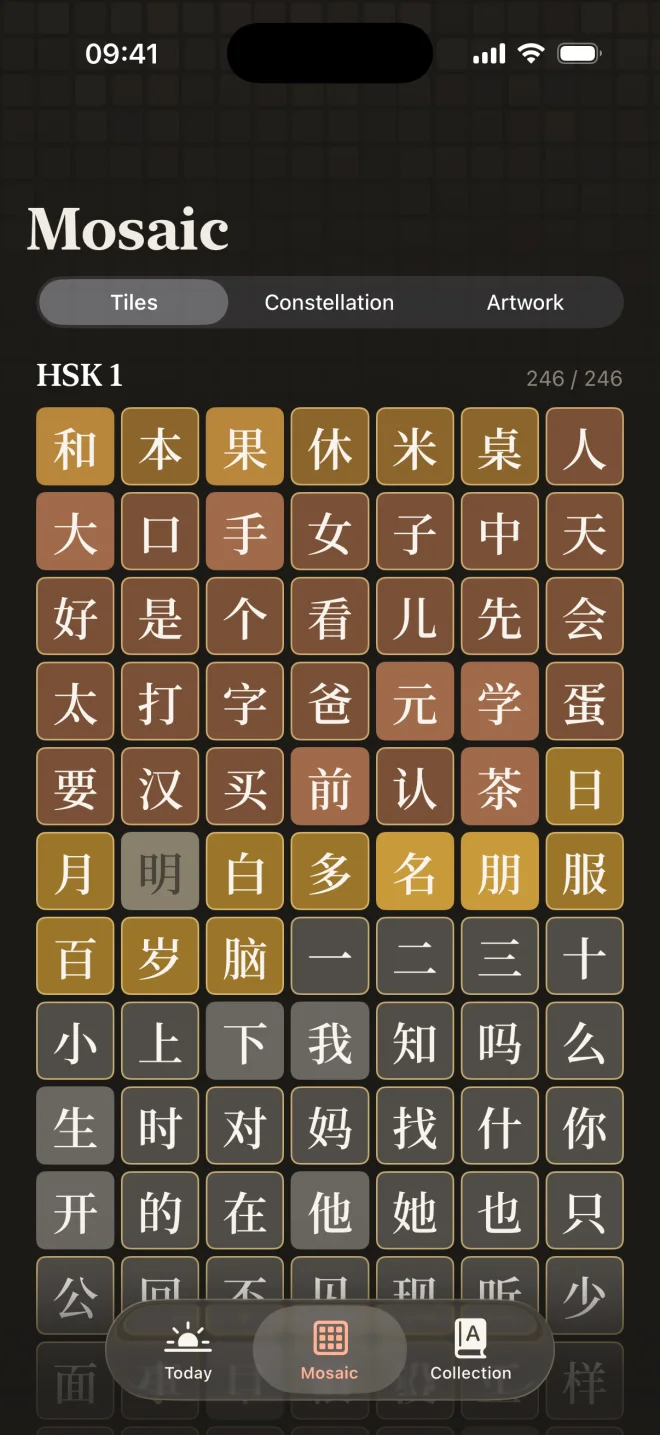
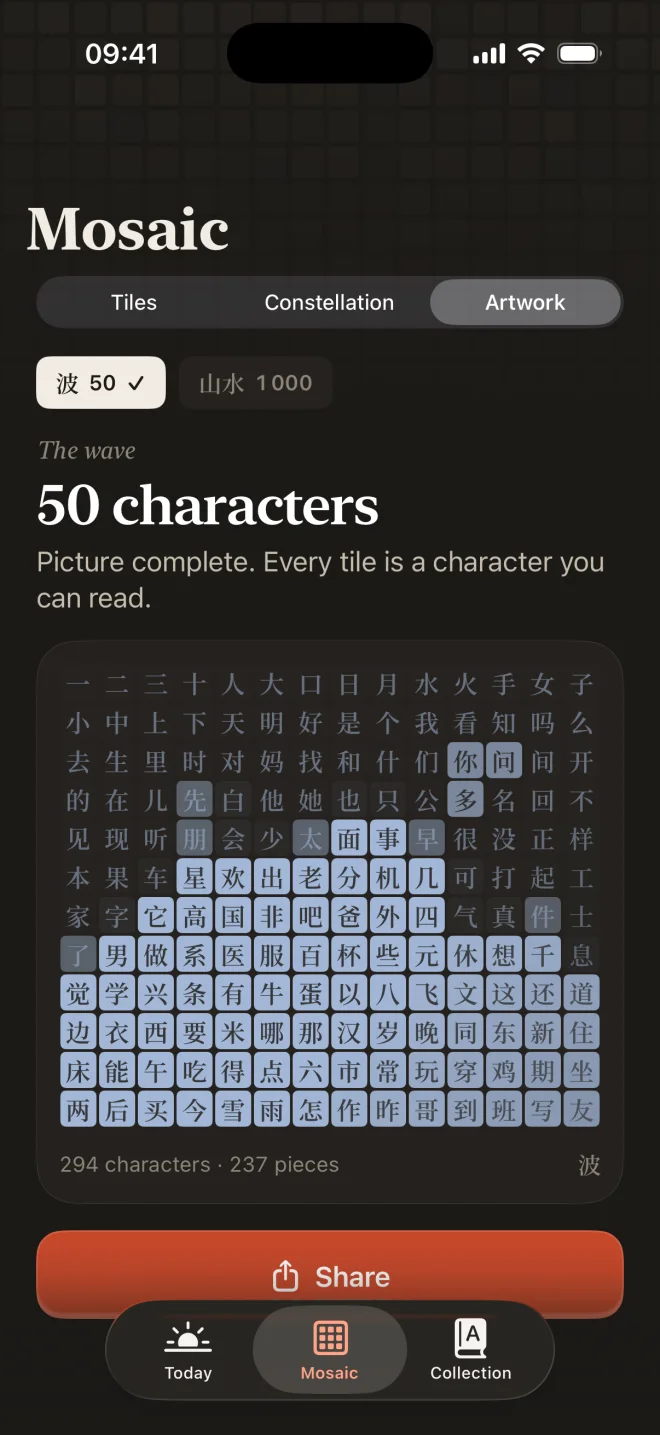
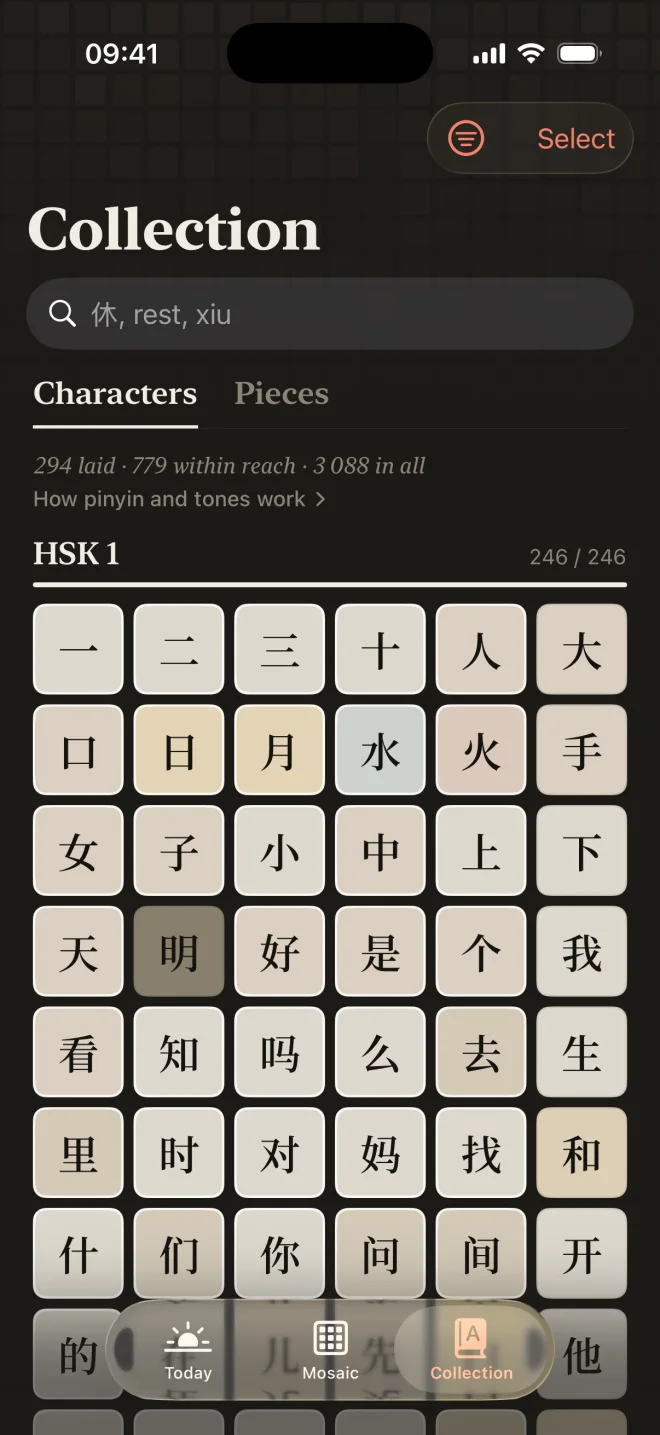
Hanzi Mosaic is a Chinese character learning app for iPhone and iPad. Instead of memorizing each character as a separate drawing, you learn the few hundred pieces Chinese characters are built from, then assemble, write and review every character. Each character you learn becomes a tile in a mosaic that grows as you study.
Which characters does Hanzi Mosaic teach?
+
All 3,088 characters of the HSK 3.0 syllabus published in 2025, from HSK 1 to HSK 7–9. They are built from 1,072 pieces and come with 5,700 HSK words and example sentences.
Does Hanzi Mosaic cover HSK 1 to HSK 9?
+
Yes. Every character is tagged with its HSK level and the course goes level by level: 246 characters at HSK 1, 125 at HSK 2, 284 at HSK 3, 441 at HSK 4, 431 at HSK 5, 413 at HSK 6 and 1,148 at HSK 7–9. Within a level, the most useful characters come first, and every piece is taught before the first character that uses it.
Can I learn traditional Chinese characters?
+
Yes. The whole course is available in traditional characters (Taiwan standard) with their own pieces, strokes, words and sentences. You choose simplified or traditional when you start and can switch any time in Settings; your progress carries over.
Does Hanzi Mosaic teach pinyin and tones?
+
Yes. Every character and word shows pinyin with tone marks, every word and sentence is read aloud, and a short guide to pinyin and the four tones comes before your first lesson.
How is learning characters by pieces different from flashcards?
+
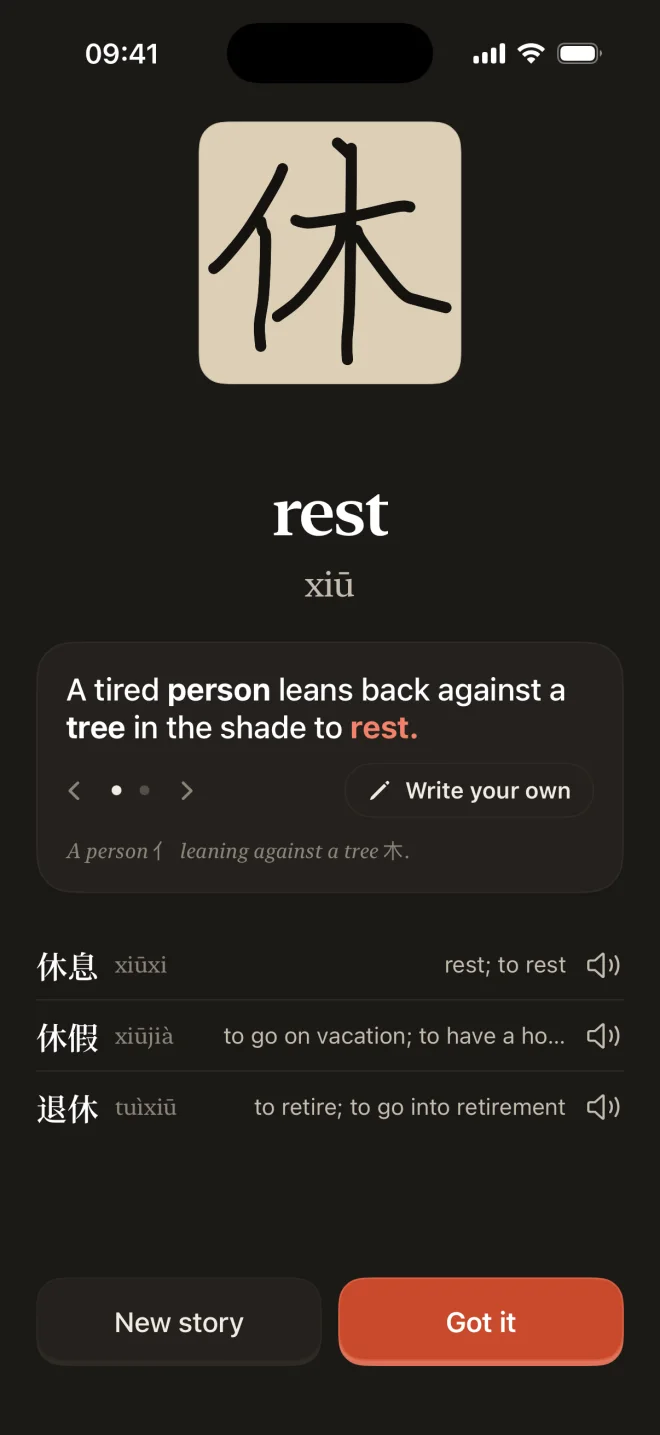
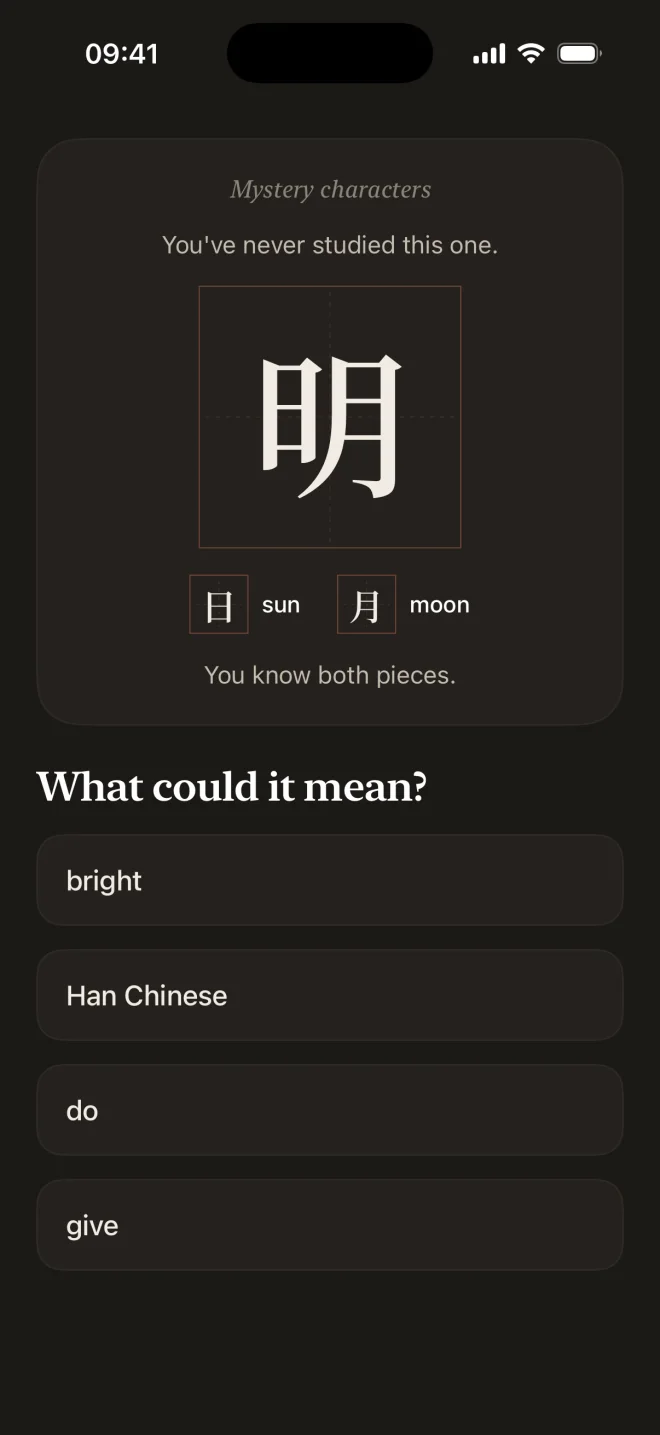
Flashcards treat each character as an unrelated picture to memorize. Hanzi Mosaic teaches the components (radicals and other recurring parts) first, so a new character like 明 (bright) is recognized as 日 (sun) + 月 (moon) rather than eight random strokes. Once you know the pieces, Mystery Characters asks you to work out the meaning or sound of characters you have never studied.
Does Hanzi Mosaic teach stroke order and handwriting?
+
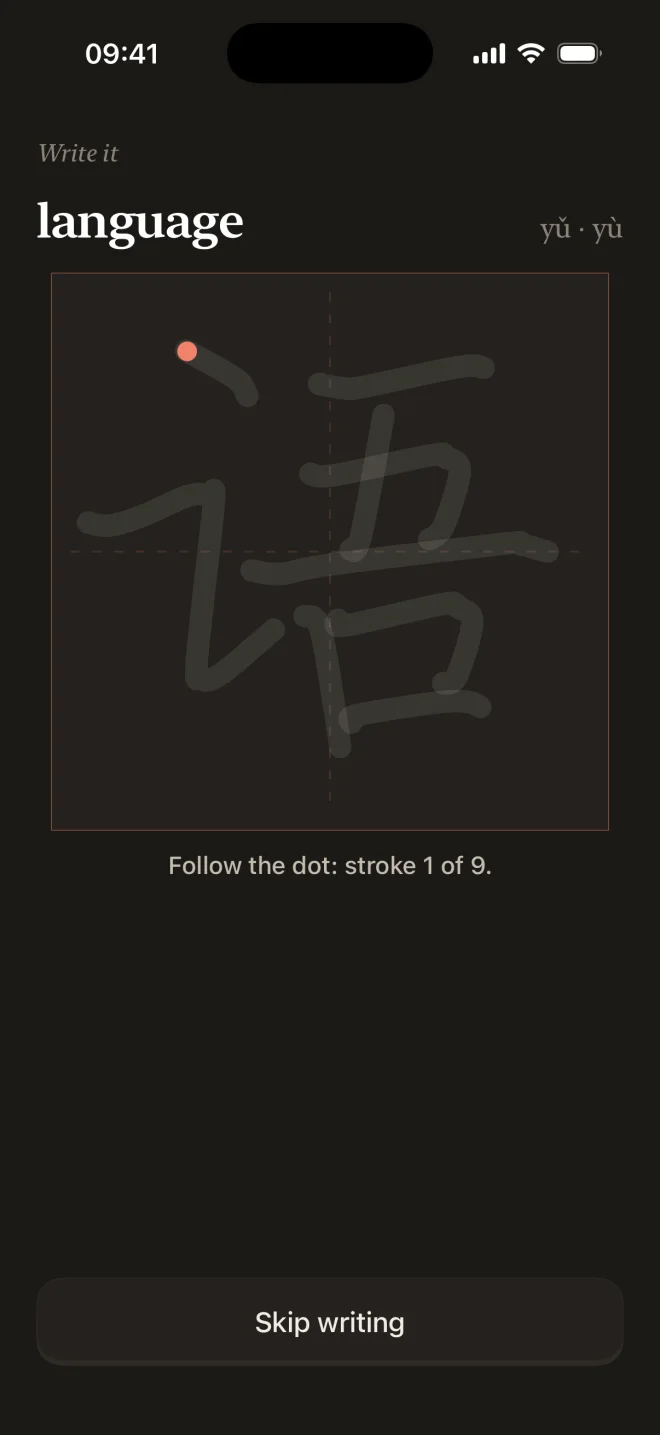
Yes. You trace each character with your finger or Apple Pencil, then write it from memory in reviews. Every stroke is checked for shape, direction and order, and the app tells you exactly what to fix. Handwriting in reviews can be turned off in settings.
How does the spaced repetition work?
+
Reviews use an FSRS-style memory model that tracks meaning, pieces, reading and writing as separate strengths, so you are tested on what you actually forget. You choose a 5, 10, 15 or 20 minute daily session, and the app balances new characters and reviews so reviews never pile up into a backlog.
Can I skip the characters I already know?
+
Yes. When you start, pick the HSK level you already know and those characters count as learned, take the placement test, or begin with your very first characters.
Is Hanzi Mosaic free?
+
Hanzi Mosaic is free to download, and the first 15 characters are free. Hanzi Mosaic Pro unlocks every character, piece, word and artwork for $9.99 per month or $39.99 per year in the US, and the yearly plan starts with a 3-day free trial. Prices vary by country.
Which devices does Hanzi Mosaic run on?
+
Hanzi Mosaic runs on iPhone and iPad with iOS 26 or later, and supports Apple Pencil for handwriting on iPad. The interface is in English. There is no Android version yet.
Does Hanzi Mosaic need an account or an internet connection?
+
No. There is no account, and lessons, reviews and handwriting checks all run on the device and work offline. Your progress and your handwriting stay on your iPhone or iPad.
Where does the character data come from?
+
Character and word lists come from the HSK 3.0 lists by krmanik (CC BY-SA 4.0); decompositions and stroke data from Make Me a Hanzi by Shaunak Kishore (LGPL-3.0, strokes under the Arphic Public License); meanings and word readings from CC-CEDICT (CC BY-SA 4.0); example sentences from Tatoeba (CC BY 2.0 FR); and frequencies from SUBTLEX-CH by Cai and Brysbaert (CC BY 4.0). Memory stories are written on top of this data.
Is there a version for Japanese kanji?
+
Yes. Kanji Mosaic, by the same developer, teaches Japanese kanji with the same method, covering all 2,136 jōyō kanji from JLPT N5 to N1 plus hiragana and katakana.